G-Code Lathe Project - The Seal Cap Part 2
Part Two - Roughing the Seal Cap with G71
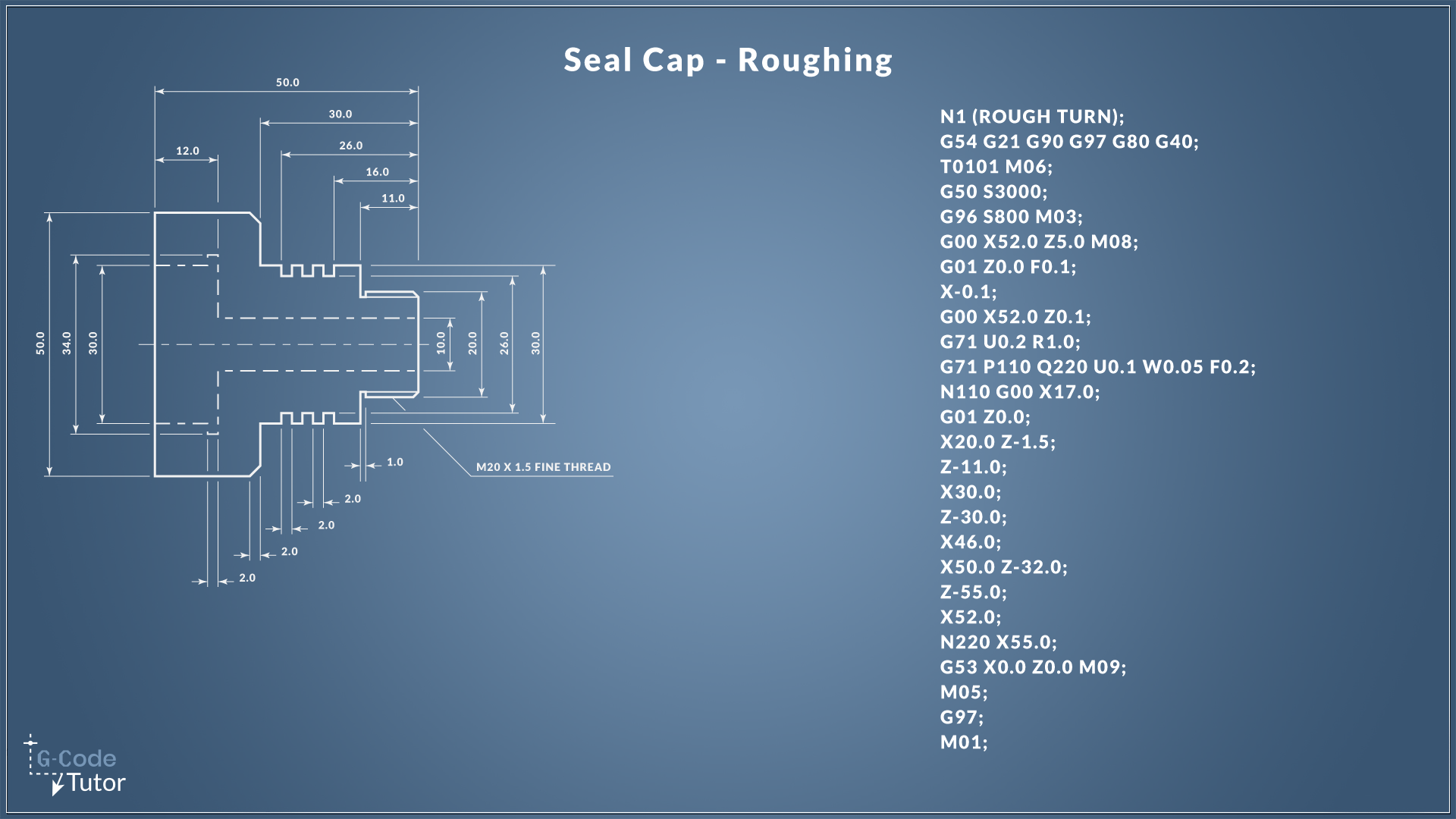
With the header done, this lesson removes the bulk of the material. The external profile steps down from the Ø50 flange through a Ø34 body, a Ø30 section that will later carry three serration grooves, a Ø26 relief and finally the Ø20 thread section, with a 1x45 chamfer breaking the flange shoulder. One continuous turning profile handles all of it.
Hand writing that shape would mean dozens of passes at each step. Instead we draw the finish profile once, as a subroutine, and let the G71 roughing cycle do the multiplying. This is the Type I single line version of the cycle: the profile must step down monotonically with no grooves in it, which suits this shape perfectly because we will machine the serrations elsewhere. The cycle line points at the start block, sets its own depth of cut and leaves a finish allowance on both diameter and face while the control works out every pass.
Tool nose radius compensation gets switched on with the very first feed move, so the cycle accounts for the insert radius across every corner and taper, and it is cancelled again on the retract. The subroutine gets written once and reused at the end of the series by the finishing cycle, which is exactly why the profile is worth doing properly the first time.
Download the full G-Code handout for this lesson, along with the complete Seal Cap program, here
This free lesson series follows the Seal Cap build from first sketch to finished part and is a taster of what you will learn in the 4-Course G-Code Bundle.
Important note
“My courses teach a generic version of FANUC G-Code that may be slightly different than the version used by your machine. By learning the generic g-code that is taught by trade schools (and me) it is easy to adapt to custom versions of the language by reviewing pre-written programs or by consulting the operators manual. There are many variables at play between machines, even two of the same machines may not safely run the same program depending on many factors. Because of this, you should never expect to be able to copy a program into a machine and expect it to work without issues. Even my programs. The example code in my videos is for training purposes only and not intended to be run in a machine.”- Marc
Share this article



Machine Shop Maths Course

For complete Fanuc G-Code Training, click here.
The quickest way to learn CNC Programming