G-Code Lathe Project - The Seal Cap Part 3
Part Three - The G70 Finishing Pass
The finishing pass is where size and surface finish are actually made, so this lesson slows things down and walks the sequence block by block. The trick that keeps the program short is already sitting in it: the profile subroutine written back in the roughing lesson gets called a second time by the G70 finishing cycle. One profile, two purposes, no duplicate code to maintain.
Before any cutting starts, the spindle speed gets clamped with G50. When constant surface speed is running and the tool faces toward centre on a lathe, the control tries to hold surface speed as the diameter shrinks, and an unlimited spindle will keep accelerating until it hits a mechanical or programed limit. Clamping the top RPM first stops that runaway.
The finishing tool approaches with a fed move rather than a rapid, cuts the profile at a lighter depth and faster feed than the roughing pass, and is returned home with a machine reference move at the end so the tool never sits parked inside a dried coolant drip or near the part. Once again, the safety line at the top of the sequence resets the machine to a known state whenever this code starts, which makes testing routines like this far easier to trust.
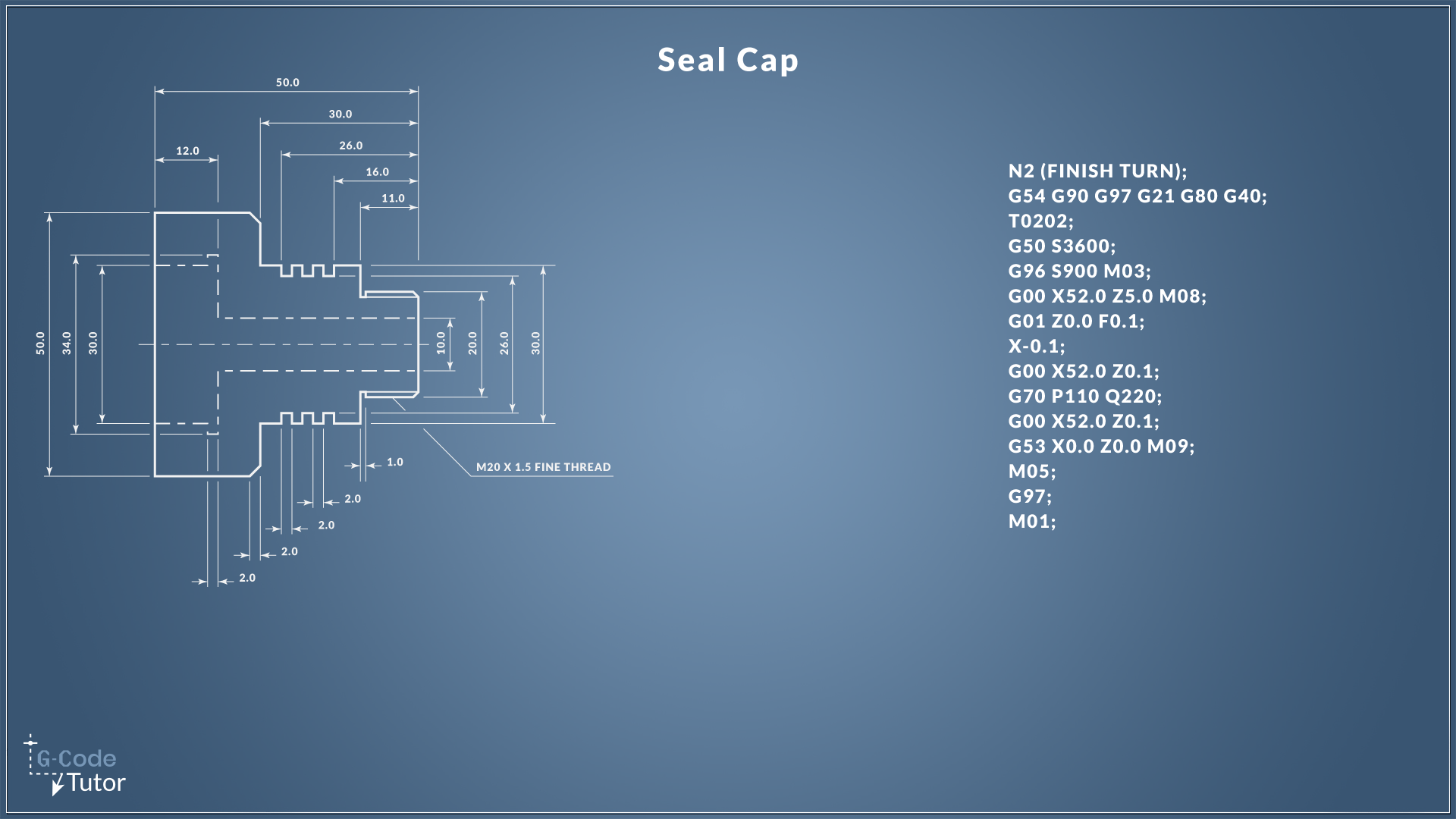
Download the full G-Code handout for this lesson, along with the complete Seal Cap program, here
This free lesson series follows the Seal Cap build from first sketch to finished part and is a taster of what you will learn in the 4-Course G-Code Bundle.
Important note
“My courses teach a generic version of FANUC G-Code that may be slightly different than the version used by your machine. By learning the generic g-code that is taught by trade schools (and me) it is easy to adapt to custom versions of the language by reviewing pre-written programs or by consulting the operators manual. There are many variables at play between machines, even two of the same machines may not safely run the same program depending on many factors. Because of this, you should never expect to be able to copy a program into a machine and expect it to work without issues. Even my programs. The example code in my videos is for training purposes only and not intended to be run in a machine.”- Marc
Share this article



Machine Shop Maths Course

For complete Fanuc G-Code Training, click here.
The quickest way to learn CNC Programming