G-Code Lathe Project - The Seal Cap Part 4
Part Four - Serration Grooves Without the Groove Cycle
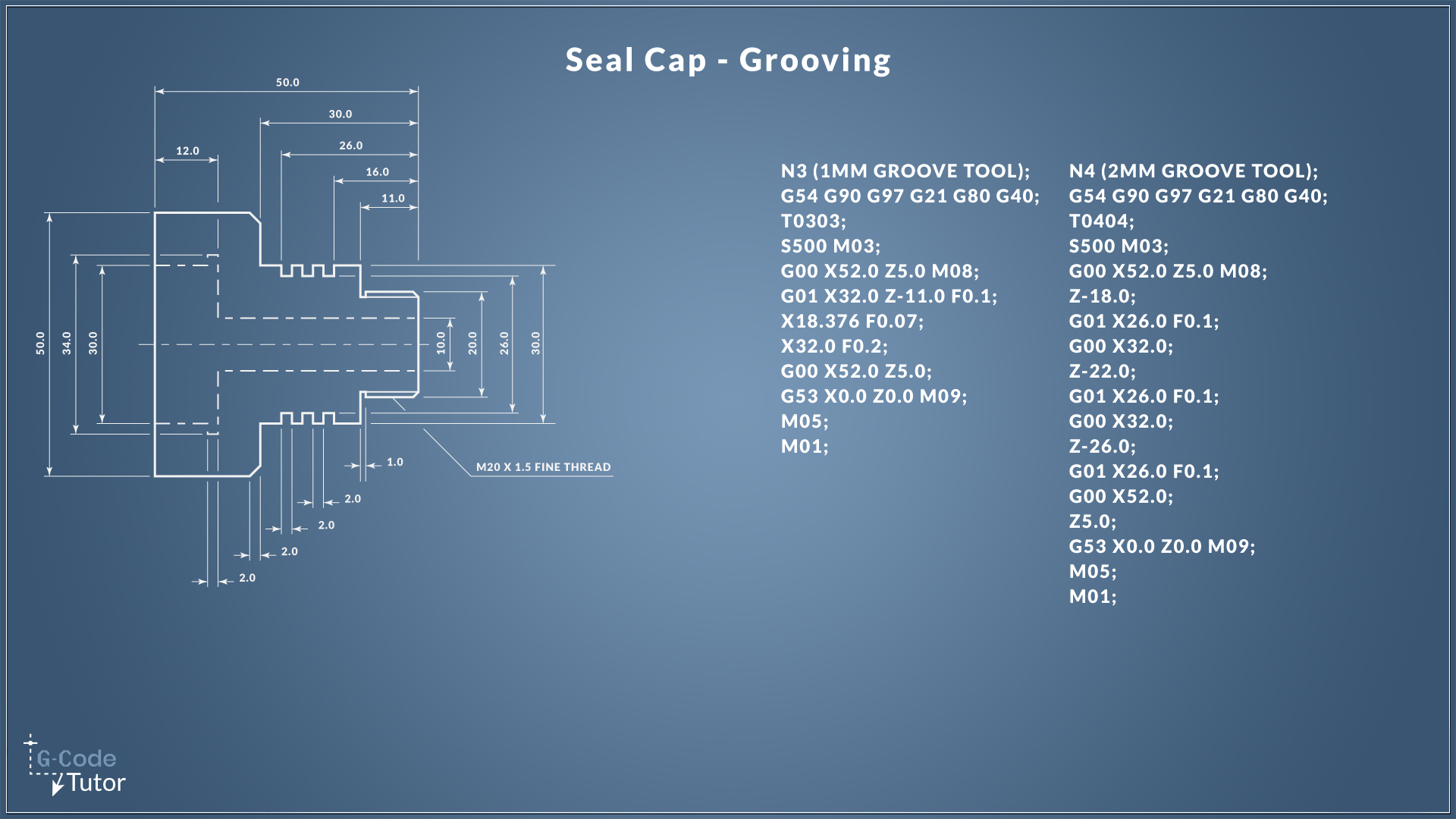
This lesson adds the small cuts that make the part work: a thread relief at the end of the thread section so the thread finishes on clean metal, and three serration grips along the Ø30 section where the user's fingers land. The serrations are straightforward grooves, 2mm wide by 2mm deep, cut down to Ø26 with each groove positioned from its own Z coordinate.
There is a canned cycle for grooving, and on this job it stays switched off. The G75 grooving cycle earns its place when the groove is wider than the tool, because it steps the tool along and pecks through material wider than the blade can chew in one plunge. Here every groove is exactly 2mm wide and the tool is exactly 2mm wide, so a plain plunge and a short axial traverse in the finish path does the same work with less code. Fewer lines means less for the next operator to unpick on the shop floor.
The radial moves feeding the tool sideways into the shoulder run at a slower feed than a straight turning move, because the blade is cutting on its edge rather than its face. Position, plunge, traverse, retract, step over to the next groove, and repeat. Knowing when not to reach for a cycle is one of the quieter skills in hand written G-Code.
Download the full G-Code handout for this lesson, along with the complete Seal Cap program, here
This free lesson series follows the Seal Cap build from first sketch to finished part and is a taster of what you will learn in the 4-Course G-Code Bundle.
Important note
“My courses teach a generic version of FANUC G-Code that may be slightly different than the version used by your machine. By learning the generic g-code that is taught by trade schools (and me) it is easy to adapt to custom versions of the language by reviewing pre-written programs or by consulting the operators manual. There are many variables at play between machines, even two of the same machines may not safely run the same program depending on many factors. Because of this, you should never expect to be able to copy a program into a machine and expect it to work without issues. Even my programs. The example code in my videos is for training purposes only and not intended to be run in a machine.”- Marc
Share this article



Machine Shop Maths Course

For complete Fanuc G-Code Training, click here.
The quickest way to learn CNC Programming