G-Code Lathe Project - The Seal Cap Part 5
Part Five - Screw Cutting the M20x1.5 Thread with G76
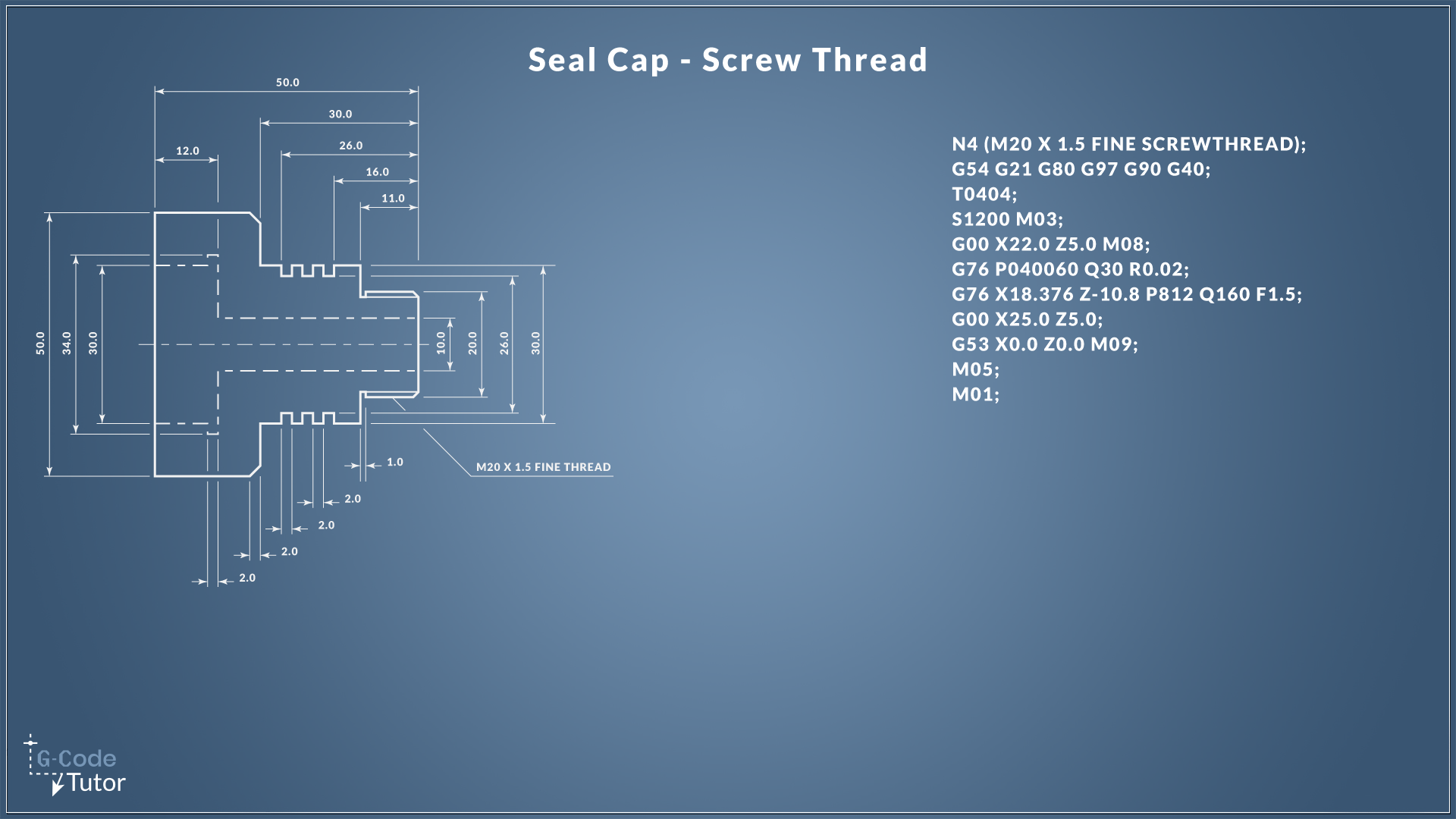
Threading is often the move new programmers fear most, and it need not be. This lesson writes the M20x1.5 fine pitch thread on the end of the Seal Cap with a two line G76 cycle, and nothing is left as a magic number. Every word of both lines gets explained against what it does on the machine.
The first line sets the character of the cut: how many spring passes run after the last cutting pass, how the tool exits the thread on retract, the thread profile angle, the smallest depth of cut the control is allowed to take, and the allowance left on the flanks for a finishing pass. The second line carries the numbers that shape the thread itself: the target diameter at the root, the length of thread, the depth from the major diameter, the depth of that very first cut, and the pitch, which here is 1.5mm.
Small habits around the cycle matter as much as the cycle. The tool is run up clear of the part before the thread starts so its first entry can be trusted, and an optional stop is inserted after the thread with a comment, so the setup can check the pitch and form with a gauge on the first article before the program continues. A safe retract sends the tool home clear of the thread flank where a careless return move could score it.
Download the full G-Code handout for this lesson, along with the complete Seal Cap program, here
This free lesson series follows the Seal Cap build from first sketch to finished part and is a taster of what you will learn in the 4-Course G-Code Bundle.
Important note
“My courses teach a generic version of FANUC G-Code that may be slightly different than the version used by your machine. By learning the generic g-code that is taught by trade schools (and me) it is easy to adapt to custom versions of the language by reviewing pre-written programs or by consulting the operators manual. There are many variables at play between machines, even two of the same machines may not safely run the same program depending on many factors. Because of this, you should never expect to be able to copy a program into a machine and expect it to work without issues. Even my programs. The example code in my videos is for training purposes only and not intended to be run in a machine.”- Marc
Share this article



Machine Shop Maths Course

For complete Fanuc G-Code Training, click here.
The quickest way to learn CNC Programming