G-Code Lathe Project - The Seal Cap Part 6
Part Six - Centre Drilling Done Right
A centre drill looks like the least interesting move in the whole program, so it is a perfect place to teach something bigger: why every line on the page is there. This lesson writes the centre drilling sequence for the Seal Cap with plain point to point programming and no canned cycle at all, and every block gets its reason stated out loud.
The centre drill spots the hole that the drilling tools will follow. On a long Ø10 through hole in a deep part, a plain drill sent in unsupervised will wander before it settles, and everything that follows inherits that error, including the bore positions. Spotting the centre first keeps the pilot drill dead on the spindle axis, which is precisely why the lathe crew never skips it on a part like this.
The sequence itself is deliberately dull, on purpose. The tool is positioned off the face, fed in at a sensible feed for the small centre bore, retracted clear, and sent home, with the safety line resetting the state at the start of the sequence and the spindle speed chosen for the tool's tiny diameter. When the code is this short, you can read it, trust it, and adapt it to your own programs without wondering what a cycle did behind your back.
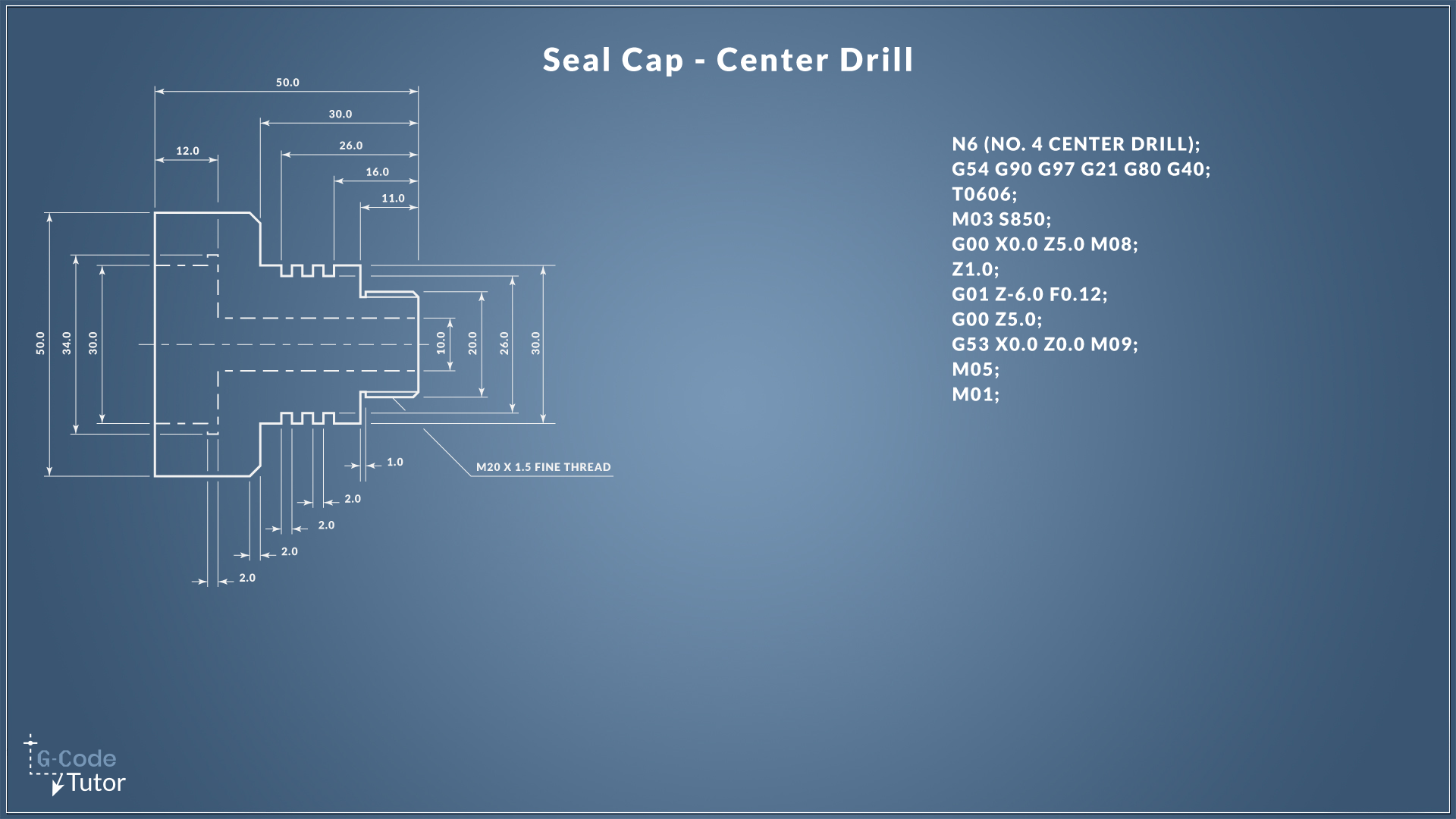
Download the full G-Code handout for this lesson, along with the complete Seal Cap program, here
This free lesson series follows the Seal Cap build from first sketch to finished part and is a taster of what you will learn in the 4-Course G-Code Bundle.
Important note
“My courses teach a generic version of FANUC G-Code that may be slightly different than the version used by your machine. By learning the generic g-code that is taught by trade schools (and me) it is easy to adapt to custom versions of the language by reviewing pre-written programs or by consulting the operators manual. There are many variables at play between machines, even two of the same machines may not safely run the same program depending on many factors. Because of this, you should never expect to be able to copy a program into a machine and expect it to work without issues. Even my programs. The example code in my videos is for training purposes only and not intended to be run in a machine.”- Marc
Share this article



Machine Shop Maths Course

For complete Fanuc G-Code Training, click here.
The quickest way to learn CNC Programming