G-Code Lathe Project - The Seal Cap Part 7
Part Seven - Peck Drilling with G83
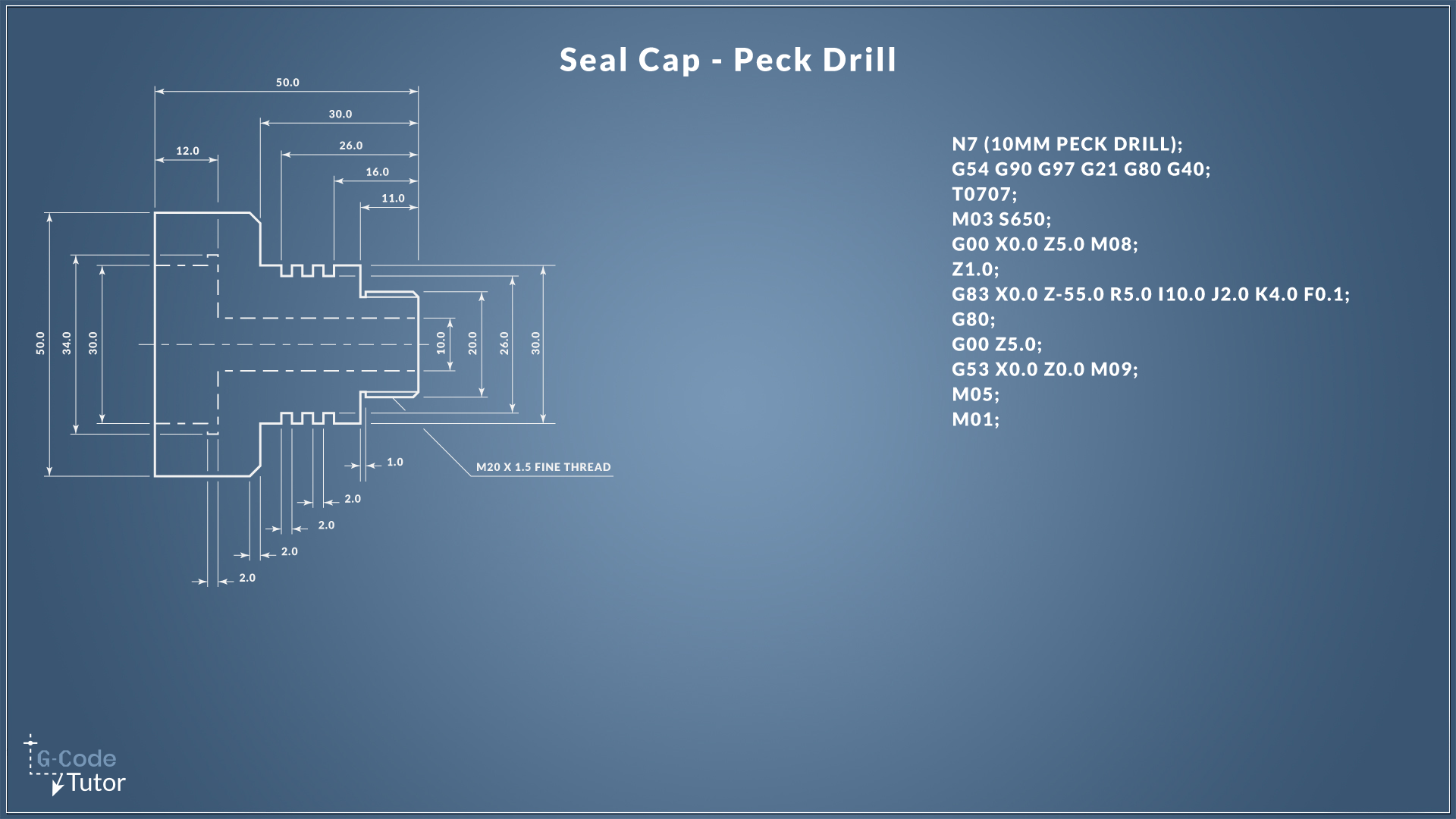
The Ø10 through hole in the Seal Cap starts life as an Ø8.5 pilot, cut deeper than the part itself so the part off tool has room to finish its cut without landing on a solid cone. Fifty plus millimetres of depth is well beyond what a plain full length plunge can evacuate cleanly, so this lesson introduces the G83 peck drilling cycle and the form of it that gives the most control.
Rather than running the cycle with a fixed peck depth, this lesson uses the parameters that step the behaviour down as the hole deepens: the size of the first cut, the amount each following peck is reduced, and a floor underneath which pecks never shrink further. The drill therefore takes a bold cut high in the hole where swarf falls freely, and backs off gracefully as the hole climbs deep and the chips have further to travel. Set against that, a dwell at the final depth and the cycle ends with the drill clear of the work.
The cycle line gets written out parameter by parameter, then the surrounding blocks: the safety line, the tool call and offset, the rapid position above the spot, the cycle itself, and a clean return that parks the tool home. As always in these lessons, check the exact parameter letters against your control's manual, because spelling changes between versions of the cycle.
Download the full G-Code handout for this lesson, along with the complete Seal Cap program, here
This free lesson series follows the Seal Cap build from first sketch to finished part and is a taster of what you will learn in the 4-Course G-Code Bundle.
Important note
“My courses teach a generic version of FANUC G-Code that may be slightly different than the version used by your machine. By learning the generic g-code that is taught by trade schools (and me) it is easy to adapt to custom versions of the language by reviewing pre-written programs or by consulting the operators manual. There are many variables at play between machines, even two of the same machines may not safely run the same program depending on many factors. Because of this, you should never expect to be able to copy a program into a machine and expect it to work without issues. Even my programs. The example code in my videos is for training purposes only and not intended to be run in a machine.”- Marc
Share this article



Machine Shop Maths Course

For complete Fanuc G-Code Training, click here.
The quickest way to learn CNC Programming