G-Code Lathe Project - The Seal Cap Part 8
Part Eight - Parting Off Safely
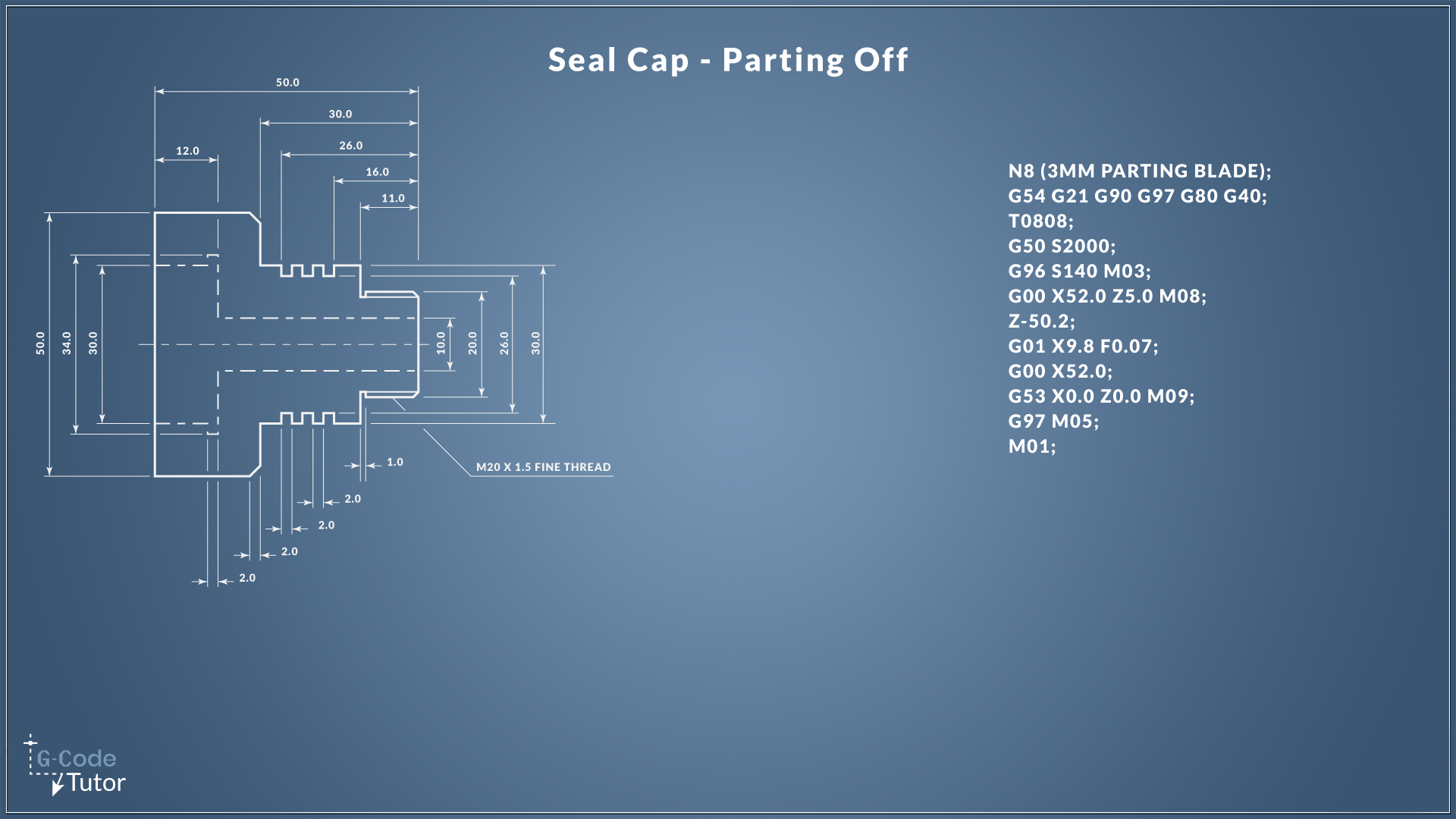
Parting off is the stage that finishes the first side of the Seal Cap, and it is also the stage where a healthy program most often turns into a broken blade. This lesson writes the cut for a 3mm wide part off blade, sitting slightly proud of the Ø10 bore, and talks through the decisions that keep it alive.
Setup habits come first: the blade rides dead on centre height, because just over centre rubs and just under centre grabs. Coolant gets aimed straight into the slot, since a deep cut traps swarf in the blade's own groove and a starved slot work hardens the metal until the blade stalls or snaps. Feed needs a considered value too, slow enough to never overload the blade, and steady enough not to rub and glaze the cut.
The program wraps the cut in breathing room. Spindle speed is capped before constant surface speed is stepped back in for the approach, clearance points sit far enough off the part to swing through without grazing the flange behind, and the cut itself is deliberately stopped short of the centre on this part so the blade is never left dragging on unsupported material. The final sliver drops with the part taken in hand, which costs a second and preserves the tool. Extra clearance before and after every cut costs nothing and gives you somewhere to catch a mistake before it costs a program.
Download the full G-Code handout for this lesson, along with the complete Seal Cap program, here
This free lesson series follows the Seal Cap build from first sketch to finished part and is a taster of what you will learn in the 4-Course G-Code Bundle.
Important note
“My courses teach a generic version of FANUC G-Code that may be slightly different than the version used by your machine. By learning the generic g-code that is taught by trade schools (and me) it is easy to adapt to custom versions of the language by reviewing pre-written programs or by consulting the operators manual. There are many variables at play between machines, even two of the same machines may not safely run the same program depending on many factors. Because of this, you should never expect to be able to copy a program into a machine and expect it to work without issues. Even my programs. The example code in my videos is for training purposes only and not intended to be run in a machine.”- Marc
Share this article




Machine Shop Maths Course

For complete Fanuc G-Code Training, click here.
The quickest way to learn CNC Programming